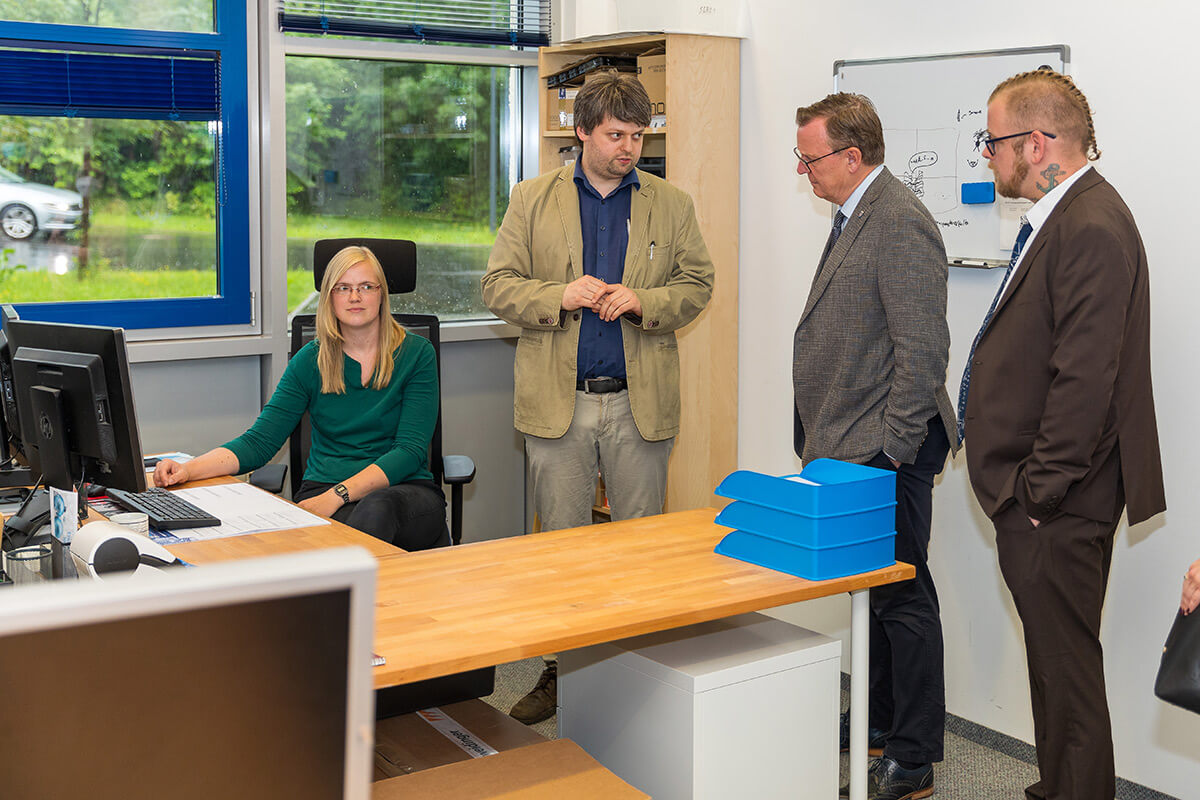
Thuringian State Chancellery Minister-President Bodo Ramelow on his “Social Cohesion” theme tour at Lynatox GmbH in the Technology and Start-up Centre on the TU Ilmenau campus, © Thuringian State Chancellery
As part of his ‘Social Cohesion’ theme tour, Thuringia’s Minister-President Bodo Ramelow visited Lynatox GmbH at the Technology and Start-up Centre on the TU Ilmenau campus on Friday 9 July – one of many companies, associations and individuals that have contributed to overcoming the crisis this year. It was founded in 2016 by TU graduate Daniel Martschoke together with Tobias Schnabel and Lars Matting as a subsidiary of Synantik GmbH, a spin-off from TU Ilmenau. At the heart of its work are the development and sale of products and systems that completely break down organic contamination in air and water by means of photocatalysis, that is, the conversion of chemical substances under the influence of light. Barbara Aichroth spoke with CEO Daniel Martschoke about his work and about Ilmenau as a centre of innovation.
Mr Martschoke, organic pollutants are found in virtually every area of life and throughout the environment, and they can have a negative effect in particular on the quality of air and water and thus on human health. Conversely, then, the technologies you have developed could bring great benefit to the environment and society?
Yes, indeed, many studies have been published recently showing a significant link between damage to health and volatile organic compounds, so-called VOCs – for example brain damage caused by plasticisers, the carcinogenic and hormonal effects of various VOCs, or sick building syndrome, that is, non-specific illnesses and symptoms that occur after spending a long time in a building. These substances can generally only be filtered out with difficulty, or broken down only with a high input of energy, for example by thermal catalysis or UV burners. With our technology we are able to break these substances down with high efficiency.
Photocatalysis is at the heart of the technologies you have developed. Probably the best-known example is photosynthesis, in which plants use the energy of solar radiation to convert carbon dioxide and water into carbohydrates and oxygen. What exactly forms the basis of the technology you have developed?
Photocatalysis, discovered in the 1970s, is a light-induced reaction process on a semiconducting material. As with a solar cell, an electron–hole pair is formed. Except that we do not generate electrical energy; instead we form highly reactive hydroxyl radicals from air and water. These react with any organic compound to produce water vapour and a little CO2 – a kind of ‘cold combustion’. The radicals are extremely short-lived (millisecond range) and are intended to remain inside our units. Several others have tried their hand at photocatalysis before us, with moderate success. Together with the Material Research and Testing Institute at the Bauhaus University Weimar (MFPA), we succeeded in deciphering the reaction mechanism and then developing our own highly efficient titanium-oxide-based photocatalyst. Another point is that very efficient solid-state UVA light sources have been available on the market for some years. Taken together, we were able to increase efficiency considerably compared with the state of the art five years ago.
What are typical areas of application for these technologies?
The classic application for air purification is rooms contaminated with pollutants, for example with PAHs, that is, polycyclic aromatic hydrocarbons such as naphthalene, but also general odour problems and hygiene purposes. In water applications we are currently working on systems for groundwater remediation and for breaking down oil films on water surfaces.
So with the help of your catalyst technology, costly remediation work can potentially be avoided too?
Indeed, we have already saved taxpayers many millions of euros in remediation costs. But even in buildings where remediation is unavoidable, our air purifiers can be used as an interim solution to allow the facility to continue operating.
Your team also works with public institutions on air quality in schools and other public buildings. What would be the benefit of these units for public institutions such as schools, and therefore for society?
Air purification at the Goetheschule Ilmenau CE-SYS GmbHIn our technology there are no used filter materials to be disposed of. Since you mention schools, one also has to ask: what will happen to ordinary air purifiers, bought now at great expense, after the coronavirus pandemic? Because of running costs and noise levels they will hardly be operated beyond that time, and they will end up in storage rooms and later in electronic waste.We do not want that, and we rely on durability, low running costs and further benefits such as generally better indoor air quality and much lower exposure to VOCs and allergens. Nurseries, doctors’ surgeries, businesses, care facilities and the hospitality and accommodation sector can also benefit lastingly.
How many years of research and development preceded the founding of your company in 2016?
Only a year and a half, plus a further five years at MFPA. But we have been working continuously, and with increasing intensity, since then on improving the technology and developing new products and further applications.
In your daily Lynatox mission you identify with the human dream of living in a world that offers healthy living conditions for everyone. Was that also your personal driving force for taking the leap into self-employment?
To be honest, not primarily. My motivation was and is to put future technologies that I came up with during school and university into practice in the form of independent research and development. It soon became clear that for this I would need far more capital than an ordinary person could earn. The idea then suggested itself of using the skills I had gained to develop and market products and to use their proceeds to develop the next technologies…
As an interdisciplinary team of scientists, engineers, technicians and business people, you work in research and product development as well as in production and sales. To what extent does networking play a role in the Ilmenau science and innovation hub, in the Thuringia region and internationally?
Networking is not just important but essential for young companies. Without networks we would have no customers, suppliers, qualified staff or access to research projects. I originally come from the countryside and see how hard it is there for a start-up to gain an economic foothold. I can only recommend that everyone network intensively with Thuringia’s innovation hubs.
I find Thuringia itself, with its large number of small and medium-sized enterprises, an ideal environment for young companies: we obtain almost all the parts we need for our products from the region, and there are many opportunities for novel services. The absence of large corporations and their recruitment programmes also makes finding suitable staff much easier than in other locations. The central location in Germany and Europe is ideal for us. Once, at a certain point, customers are spread across Germany, the exact location no longer matters so much – as long as it is Thuringia!
In an international comparison, however, we still have considerable catching up to do when I see the commitment shown to young companies in the USA or China… people here can only dream of that.
As a graduate of TU Ilmenau you bring extensive knowledge of power electronics and have, over the years, also gained extensive experience in developing products and business models, which you can now bring to your work as company founder and CEO. What else should a founder bring to the table?
Perseverance, even when something does not work straight away, but also the courage to change business models radically when opportunities arise. For all one’s love of technology, one must never lose sight of the fact that the company depends on operating profitably, and quickly. Otherwise you soon have no reserves left to invest in new areas. This flexibility is often the only real advantage small start-ups have over large companies. Of course, it is also very important to have appropriate life goals and a strong team that keeps motivating you.
To what extent did your studies in Ilmenau, the support from TU Ilmenau’s start-up service and the proximity to other young and dynamic companies at your company headquarters in the Technology and Start-up Centre on the university campus help you in setting up the company?
The expertise and working methods I was able to acquire at the university are the foundation of our company. The Research Services and Technology Transfer office and the start-up service, represented by Dr Gerhardt, were our first port of call: they established initial contacts and supported us as far as possible with all questions about setting up the company. Through our location at the TGZ we have won important customers – not least because companies explicitly and proactively look for technical solutions in Ilmenau. Partnerships and business cooperation are also developing with other young companies, for example with CE-SYS Engineering GmbH. CE-SYS Engineering GmbH supports us with indoor air simulation and with determining the optimal positioning of our units in the room.
Five years after the founding, you are still working closely with TU Ilmenau, in particular with the Inorganic Non-metallic Materials group in the Faculty of Mechanical Engineering, headed by Prof. Edda Rädlein. What does this collaboration look like?
We jointly supervise students on their final theses and have already taken on graduates as employees. The expertise of the group has also helped to improve our technology. Last but not least, through the close collaboration we also have access to professional measurement technology, and we are currently also planning cooperation projects in research and development.
We look forward to that – good luck with it and thank you very much for the interview!