

The facts

Location
Swisttal

Sector
Heating oil contamination
Removal of MOH
after flood disaster
The Lynatox units are fascinating. Despite a sound knowledge of the fundamentals of physics, I could not have imagined how powerful the units are. In my case the smell of heating oil was completely eliminated.
Markus Freyermuth, Swisttal
Effective solution against mineral oil hydrocarbon (MOH) contamination after the flood disaster
The challenge: MOH contamination in living space
In July 2021 the devastating flood disaster hit Swisttal in North Rhine-Westphalia with full force. Besides massive destruction, it caused a serious environmental problem: numerous heating oil and vehicle tanks were damaged, releasing hazardous mineral oil hydrocarbons (MOH). These substances, known as solvents or constituents of oils and fuels, penetrated deep into the masonry of an affected private house.
The problem: persistent oil smell despite renovation
A typical feature of MOH is its intense, petrol-station-like smell, which cannot be removed by ventilation alone. Even after repeated renovation measures, the smell of oil remained in the house and made the building almost uninhabitable. The deep-seated pollutants confronted the homeowners with a difficult decision: a lengthy and possibly unsuccessful renovation, or the complete demolition of the building.
The solution: air purification as a last alternative
Faced with this hopeless situation, the residents turned to us. Our air purifiers offered an alternative to demolition. We were able to begin installation immediately. Over a period of eight weeks, the air purifiers were deployed in the stairwell, living room and boiler room.
Result: restoration of living quality
Through continuous air purification, the pollutant levels were reduced and the disturbing oil smell was no longer noticeable. The residents were able to use their house again without restriction – a result that shows air purification technology can be an alternative to costly renovations in suitable cases.
The solution
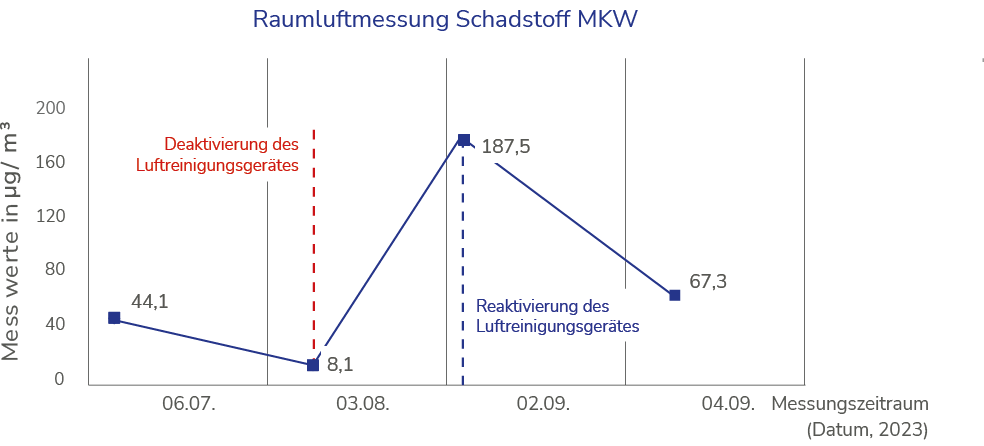
Figure 1 – Measurement, stairwell
Figure 1 shows the course of the measurements in the stairwell. In the first period of use, of almost 4 weeks, a clear reduction of the pollutants can be seen. With prolonged use, a further reduction can be expected. After the unit was switched off, a sharp rise in concentration can be seen. It is also clearly visible that the concentration rises above the starting value. A likely explanation is that the air purifier breaks down not only MOH but also other organic indoor air pollutants in the room. The resulting concentration gradient is then greater and may provoke higher outgassing (diffusion) of MOH from the masonry. Through this effect, the pollutants may be driven out of the masonry and broken down more quickly.
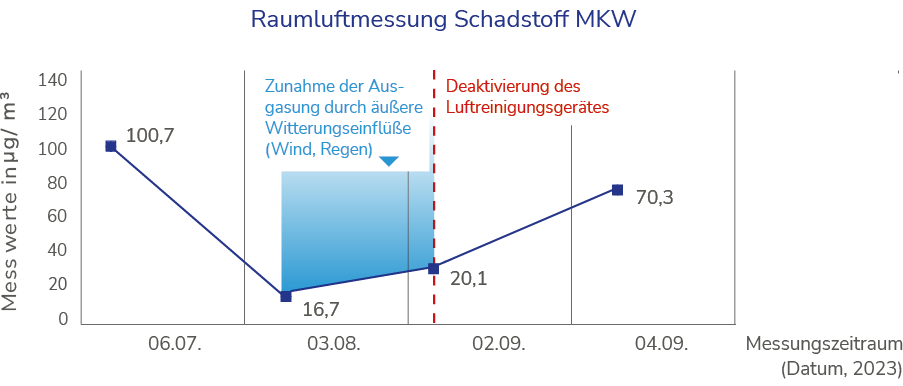
Figure 2 – Measurement, living room
Figure 2 shows the breakdown of the MOH very clearly. The measurement data also show that after deactivation the pollutant concentration rises very markedly within a very short time. Between the 2nd and 3rd measuring points, outgassing was additionally increased by external weather influences (wind, rain). A slight rise in concentration can be seen here; the air purifiers were nevertheless able to prevent a stronger rise and would have reduced it further with longer use.
By positioning our air purifiers deliberately, the living quality of the premises was restored. Within a period of 8 weeks a clear reduction in pollutant levels was achieved, as the diagrams show. With continuous use, a further reduction can be expected.
After the air purification units were deactivated, by contrast, a significant rise in pollutant levels was recorded within a few days. This indicates that the reduction was due to the units. Both the pollutant expert and visitors to the house confirmed that they could no longer perceive any odour after the units were put into operation. This considerably improved the residents’ well-being. Continuous use of Lynatox air purifiers can bring a noticeable improvement in indoor air quality.

Figure 3 – Boiler room
Figure 3 shows another sharp rise in MOH concentration at the end of the period of use. This is due in part to heavy rainfall in the meantime. This subsequently led to water ingress and the pollutant being washed out of the cellar walls. The subsequent drying and evaporation of the water increased the concentration sharply once more.
Conclusion: successful removal of MOH in living spaces
improvement in air quality
Air quality
Lynatox air purifier LRG 1200 3.0
Product
Lynatox industrial air purifier 5000
Product
weeks of test installation

